

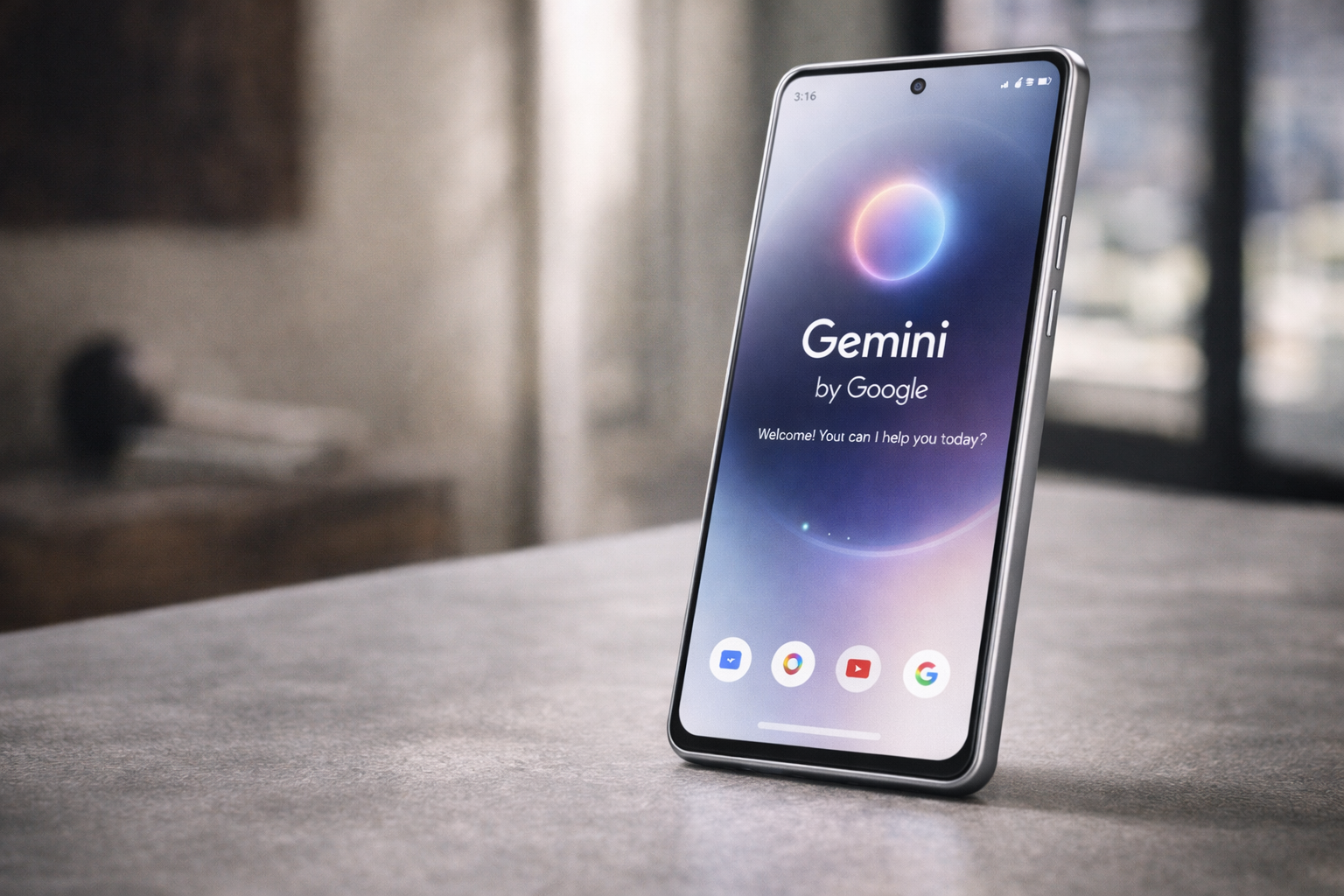
Google is moving artificial intelligence on smartphones beyond suggestion engines and smart replies. With its latest rollout, Gemini is beginning to automate multi-step tasks directly on supported Android devices, including the newest Samsung Galaxy S26 series and Pixel 10 models. The shift signals a deeper transformation in how smartphones function — not merely as reactive tools, but as semi-autonomous digital assistants.
Unlike earlier AI integrations that required manual prompts or isolated commands, Gemini’s updated capabilities allow it to execute chained actions across apps. In practical terms, this means a user can request a task such as booking transportation, drafting a message, or organizing calendar events — and the system handles the workflow without repeated confirmations.
Automation Moves Into Everyday Use
Google describes the feature as a step toward “agentic AI” on mobile devices. Rather than offering recommendations, Gemini can now interpret intent and perform structured actions within supported applications. According to reporting from Moneycontrol, Gemini can place ride bookings or food orders directly from conversational input, minimizing app switching and manual entry (Moneycontrol report).
The rollout is initially focused on high-end Android devices capable of handling on-device AI workloads efficiently. Samsung’s latest Galaxy S26 models and Google’s Pixel 10 lineup are among the first to receive the deeper integration.
How It Differs From Previous Assistants
Voice assistants have existed for over a decade, but most interactions remained limited to single-step commands: set a timer, send a message, search the web. Gemini’s new functionality aims to manage sequential tasks — a capability that reduces friction in daily digital routines.
- Cross-app execution without manual toggling
- Context retention during multi-step workflows
- Adaptive learning based on user behavior patterns
- Improved integration with Google services such as Maps, Calendar, and Gmail
Google previously detailed its broader Gemini roadmap in its official developer communications, highlighting the company’s ambition to embed AI deeply across Android experiences (Google blog announcement).
Security and Control Considerations
Greater automation introduces new questions about data handling and permissions. Google states that users maintain control over which apps Gemini can access and what level of autonomy it receives. Execution typically requires confirmation layers depending on task sensitivity, particularly when payments or location data are involved.
The move also reflects increasing competition in AI-enabled ecosystems. As smartphone manufacturers integrate proprietary AI layers, Google’s strategy appears aimed at maintaining Android’s central intelligence layer rather than ceding automation control to hardware partners.
Market Impact
The broader implication is that AI may become a deciding factor in premium smartphone purchases. While camera hardware and display quality remain important, automation efficiency could redefine perceived value in high-end devices.
For Samsung, early support for Gemini automation strengthens the positioning of the Galaxy S26 as an AI-centric flagship. For Google, embedding automation directly into Android reinforces the company’s influence over the ecosystem’s direction, particularly as competitors develop alternative AI frameworks.
A Shift Toward Semi-Autonomous Smartphones
The transition from reactive assistants to proactive execution systems marks a subtle but important evolution in smartphone design philosophy. Devices are beginning to interpret intent rather than simply respond to commands.
Whether users embrace this level of automation will depend on reliability, transparency, and perceived convenience. If execution proves seamless, AI-driven task management could quickly move from novelty to expectation — reshaping what consumers define as a “smart” device in 2026.